10/31/2007

Criminalized Apples
Come Halloween, who among us has not occasionally felt the urge to embed razor blades in crisp ripe apples, dip those apples in yummy candy or caramel coatings and serve them up on sticks to eager ghosts, goblins, witches and princesses?! Or simply sprinkle roach powder on fresh popped popcorn? But then you think:
1. Ok, but too much work.
2. Homemade stuff is easily traceable back to its source.
3. I’ll come off like some homemade hippie cheapskate even before I’m arrested and my house will probably get egged.
4. The candy industry, in the face of a surge in homemade hippie cheapskate types in the late 60s/early 70s, managed to convince the American public that anyone handing out homemade treats on Halloween is either:
a. A serial killer
b. Homemade hippie cheapskate type
Thus, even if you do decide to go to the trouble of doctoring you own homemade treats, most kids are trained to throw the stuff out and call the police on your striped and drawstring panted ass.

So, what’s a Halloween tamperer to do? Sadly, there’s not much that can be done. I know, I know, it’s tempting to give in and just waddle down to the local Duance Reades and buy a bag of mini O’Henrys or Snickers. Sure, it’s easy and anonymous enough to buy the candy and use one of Uncle Ed’s (dirty) insulin needles to shoot a bit of “I’m sleepy” juice into the heart of a Three Musketeer bar. But is it truly feasible and worthwhile? Let’s consider:
1. Where’s the fun in doing that?
2. How will anyone ever know it’s you? On any given Halloween there are about 3 million Milky Ways floating around—no one could ever trace one poisonous bar to one poisonous person. How will you ever get your 15 minutes of fame and ripped from the headlines tv emulation?
3. Little do most prospective candy tamperers know it, but the same candy industry that criminalized homemade Halloween treats also invented impervious candy. If you’re a first-time candy tamperer, you may not know it, but what looks to the naked eye a lot like a lump of variegated corn syrup wrapped in brightly colored paper is really a “smart” nugget. “Factory sealed” does not just mean that the wrapper has been machined glued shut in a factory manned by underpaid workers who just lost their pensions and health benefits and who would, therefore, never in a million years have any motivation to sabotage their company by tampering with its product. No, my friends, “factory sealed” means hermetically sealed in a wrapper that only looks like paper, but is really a micro-shield impervious to needles, gases or even radiation of any kind. The only method of penetrating these wrappers is with the use of fat little fingers eager for more, more, more!

The only thing for a would-be candy tamperer/apple trapper/popcorn poisoner to do is relent and give up on the whole urge. The Mars company and others like it, through their wisdom and care, have made it impossible for the average ne’er do well to ne’er do well. The only way our children can be harmed now on Halloween is via the traditional twin pillars of sugar and fat. The only thing left for those of us who prefer trick to treats is to give up on the whole treat giving business all together. Get out of the house and do a little trick or treating yourself. Dress up like a homemade hippie cheapskate handing out homemade treats. That’ll scare the crap out of them.

10/09/2007

Design Flaws


Due to circumstances beyond our control [too much wine at a benefit auction], we ended up renting a house in Maine for a week in August. Camden, Maine—the prettiest town in Maine—or so we were told. What we were not told is that US 1 runs directly through the town as it does through so many of Maine’s charming coastal villages. The “1” it would seem stands for “the ‘1’ and only road in Maine.” Without exaggeration there was more traffic on that road then on 106th St. on any given day. A perpetual flow made more pokey because in Maine if a pedestrian so much as dangles a pinky toe onto the road, all traffic must instantly stop. This means that anytime a tourist can’t decide which side of the street to stroll down, coastal Maine grinds to a halt. And there was no shortage of pedestrians. The highway was jammed with broken heroes: tow headed kids and their clenched parents sprinkled in among the heartier locals—white haired ruddy skinned men and women nearly alike to one another with their large sunglasses, high pants and low breasts. And who says WASPs don’t age well?

Here’s what else I learned about WASPs on my summer vacation:

1. They lack joie de vivre.
2. Not only do they lack joie do vivre, but to the WASP, in the cold stone sober light of day, Joie de Vivre and Bonhomie are just two more towns in France they’ll never visit unless forced to as part of an invading army.
3. They’re generally much better at golf than I.

On a less cantankerous note: Belfast is a lovely town. If you go there and choose to take a Lobstering Cruise on the Good Return, afterwards have Captain Melissa Terry direct you to her uncle, Mike Hutchings. He’s the harbor master and he sells lobster, clams and crabs from his home a little bit inland. Generally speaking, as we slowly learned, if you want to get away from the brutal triaffic and $40 lobsters, you have to go a little bit inland—it’s a whole other Maine.

http://www.belfastbaycruises.com/cruiseinformation.html

Mike Hutchings, M&L Seafood, 638 Beach Road, Lincolnville, ME 04849, 207.763.3983.


iMiracle

The other day I searched through all my 46 of my Ween songs for a particular dittie. I couldn’t remember the piece’s title but I had a sense of what it might be called. Finally despairing of finding it, I flipped on “Shuffle Songs.” The song I had been searching for popped up first: Mutherfuker by Beck not Ween. The odds of that occurring: 1 in 2587.

My erstwhile assistant told me that kind of stuff happens to her all the time. Any other icoincidences out there?


The End of the Ave


Beth and I were painting the attic floor of what was to become the boys’ bedroom of our brand new 1840’s farmhouse just up Rte. 217 from Philmont, NY. As we were spreading newspapers, Beth noticed Edward Avedesian’s NY Times obituary among them. Avedesian had died in a nursing home about ½ a mile down Rte. 217 from our brand new 1840’s farmhouse.

Back in 1994 when I was a younger art writer still happily careening about what was still a gallery packed Soho, I came across the works of Avedesian in a little storefront gallery off Sullivan St. The gallery was run by a NY city public school science teacher named Mitchell Algus. That far corner of Soho soon became my de facto home away from home, and Mitchell’s first show of Avedesian’s there blew my fucking mind.

The Avedesian show was one of the first strands of many lost threads that Algus gathered for those of us who were lucky enough to find our way to him. Many of Algus’ lost lights were brilliant and some were better left unlit, but none were as gripping or revelatory as those early Avedesians. Here were flat abstractions that were pure sight: the first glimmer of post hypnotic pop op absent any of the acid tainted automations that were to color most subsequent efforts. Avedesian left those paintings as a gift for us and continued along his path.

The rest of his path may not have been for most of us: “textured” abstractions, Birchfieldesque landscapes and Paul Cadmus redux—manly men fixing cars in the Hudson valley, but it was Edward’s path and he diligently followed it; career be damned. That’s the way an artist does it.


Gandalf’s Staff

Some very thoughtful people made it possible for Beth and me to be in the center of the front row of the Harvey Theater for the first U.S. night of the Royal Shakespeare Company’s production of King Lear. I’d always loved Lear and I really wanted to see Sir Ian’s stab at it. I won’t kid you: Magneto and Gandalf sealed the deal for me with Mckellan—in my book he earned his peerage just for the way he stood there when he first entered as Gandalf the White in Two Towers. Sir Ian did not disappoint, but Trevor Nunn and most of the RSC did.

Whereas McKellan gave it his all to lend Lear the air of verisimilitude, the rest of the company and the production mostly did everything but: we had a slow motion suicide by a poor old Gloucester who seemed, like many in the cast, to be still jet lagged. Scary to think they might all be tired given that the company will be doing double duty on Lear and The Seagull—sometimes in the same day. The stage fights were about as real looking as those in old Star Trek episodes, and, when the Fool was hung in plain sight on stage, he struggled about as valiantly as Paris Hilton would against a strip search.

Speaking of stripping: in a subplot that parallels Cordelia’s plight, Gloucester’s son, Edgar, is cast out and criminalized. In order to protect himself he takes on the persona of Mad Tom, strips off his clothes, rends his flesh and rolls around in the mud. In the text there are numerous references to Tom being naked, but in this production he wears a loin cloth. Even though the dude playing Tom and the rest of the cast, chose to be soft in their choices, Sir Ian refused to rest on his laurels. When the rapidly deteriorating Lear decides to emulate Mad Tom, our valiant hero [McKellan not Lear] decides to get real and truly naked in the middle of the stage. And there it was: Gandalf’s staff waving in the breeze and me and the mrs. just 10 feet away.

--You shall not pass!

You bet your flat white ass we won’t—now put that thing away before you put out an eye, pal!

Even more distracting than Sir Ian’s Willy, and for reasons that I’ve yet to figure out, Trevor Nunn dressed the cast like 19th Century Russians. It did not seem as if there were any point to that choice besides his wanting to look at a different era of clothing for a change; there’s not a lot of coin to be made going after late Czarist Russia. If Nunn were looking to make political parallels why not put them in Blue Brooks Brothers suits with red ties and be done with it, or just do the friggin thing right:

Lear is a an all-out pagan bloodbath and blood rite. It starts as if it were the ending to a traditional Shakespearian comedy--as a buildup to a wedding, and then something goes horribly, horribly wrong. One old man’s folly leads to 10 of the cast killed by the entire spectrum of means [Shakespeare really emptied his kit bag out in this his last tragedy] and a war between England and France [though most anything could have caused that back then]. What we are left with after this bloodletting is no burst of wisdom or moment of clarity [or lasting democracy], but rather just “Howl, howl, howl.”

Nunn made sure we were aware of the pagan aspect of Lear’s time. When characters in the play beseeched the heavens, they did not pray to JC or his Dad, but most pointedly to pagan gods instead. Too bad Nunn didn’t also stage the play as the pre-Christian, pre-Roman primal bloodletting the damn thing was crying out to be and put the fire to his players to boot. Howl, howl, howl…

Jerry Saltz’s Balls

Jerry Saltz has more hair on his balls than any other art critic has on his balls [or her ovaries]. Not only does he speak truth to power, but unlike the rest of us safely sniping from the sides, Saltz goes after power he undoubtedly rubs elbows with at this function or that. In an art world in which people are notorious for not putting anything at risk ever—even when there’s precious little to risk—Saltz continues to go all in. He is making the most of his new perch at New York, slowly turning it into a bully pulpit. Bully for you, Jerry. Rave on.

8/01/2007

Sometimes It’s Not Beauty, Just Youth

I was walking across 23rd St. Claryssa Dalyrimple was sitting outside the Half King with some pretty young thing. They were looking at some sort of images between them on the table. I first crossed paths with Dalyrimple more than ten years ago. She wasn’t young then. She looks younger now. Watching her with the pyt, it struck me more starkly than ever how much the old feed off youth in the art world—suck it down like blood from the ripe jugular of a pale virgin.


"You Always Move In Reverse," curated by Bjarne Melgaard

Leo Koenig Inc., 545 West 23rd St [betwn 10th & 11th Aves],212.334.925,
http://www.leokoenig.com

Through July 31, 2007


Ever since I first read about this gallery in a profile of Koenig in the New Yorker, I have hated it. Though young himself, Koenig came across as a Teutonic youth monger. This summer’s show is all about what those crazy kids are up to now. Or circa 92. I dunno. There is a bit of a visceral jolt awaiting you when you peek into the black curtained backroom. A slight edge. And so much wanting there to be an edge.


Banks Violette

Gladstone, 515 West 24th Street [betwn 10th & 11th Aves], 212.206.9300,
http://www.gladstonegallery.com/default.asp

Through August 17, 2007

Banks Violette has the kind of name and back story that Jewish boys from the suburbs can only envy in a deeply sour way. If Banks hadn’t been born, Larry Clarke would have found him anyway. He’s the kind of blazing emblem for youth that warms the crinkled eyelids of the old. Fortunately he does this with more than a good backstory, a whiff of crystal meth, and Goth, Goth, Goth [or whatever hairsplitting denomination it’s meant to be called]. He does it by freezing time, salting away light and sound: he casts light fixtures and acoustic tiles in salt dessicating our senses, then he pumps liquid nitrogen to stop time—even our beloved 2-D planes, our getaways, are blocked—no space here just black or sheet metal flats, and imploded mirrors frosting over. Time stops; our image in the glass freezes. We are all Clarissa Dalrymple.

Violette’s touch is less abject than it was in the early Team days; given his huge budget it would be disingenuous for it not to be. Still he often owes more to Stockholder than Barney and manage bits of tenderness [horreur!] amid formal grace: orange and white ipods here, a $20 hardware store fan there, and one deep bowel cleansing note that rumbles across the black floor like that first great fart of the day.

Not just youth.

7/18/2007

* * *

SUMMER OF LOVE 07


Susan Inglett Gallery, 534 West 22nd Street [betwn 10th & 11th Aves], 212.647.9111, http://www.inglettgallery.com.

Through August 3, 2007.


I’ve been following Susan Inglett around since she was in Soho. Her spaces then and since have always seemed more than a little ambivalent. In Soho you had to be buzzed in, she’s had a few spaces in Chelsea that weren’t always open and often had more work in the office than in the gallery. Currently she continues to challenge the shy by proffering works in her tiny sheltered office, but her current space is at least and at last street level and readily accessible [don’t become too enamored of this space: in October she’s moving to 522 West 24th St]. Regardless of location, Inglett has always shown smart work, but her intelligence has never gone to her head. Her current show is no exception.

Annette Lemieux’s piece is a little too on the nose, but given that it’s summer and we’re all a little slow, we need something to make us realize what’s going on in the other works by Simone Shubuck, Greg Smith, and Christopher Ulivo and Bruce Conner. What we have here is a quietly brilliant discussion of good old fashioned imperialism suddenly made new again by the current administration.


CONCRETE WORKS

Mitchell-Innes & Nash, 534 West 26th Street [betwn 10th & 11th Aves], 212.744.7400, http://www.miandn.com

Through July 27

Going forehead to forehead with Susan Inglett is Jay Gorney who curated this crisp and deeply engaging affair. But whereas Inglett’s show is all about deceptively poignant content, this show is a strictly formal affair designed to deceive and challenge the eye. Some crazy smart heavies play light in the joyous a/c: Stockholder, Welling, Oehlen, Moholy-Nagy, Beshty, McKenzie, Lefcourt and Man Ray painting.

The greatest joy of this show is that you get to think of some of the issues Frank Stella has taken up over the years [the best thing about Stella] without having to look at any of his actual artwork [the worst thing about Stella].


MARLÈNE MOCQUET: Recent Paintings
Project Space: SYLVAN LIONNI, Zugzwang


Freight & Volume, 524 West 24th St. [betwn 10th & 11th Aves], 212.989.8700, www.freightandvolume.com

Through August 17, 2007.

Marléne Mocquet, Fingers on the Hand of the Birdmixed media on canvas, 13 x 9", 2007
I was walking around openings one evening alternately being appalled and ignored by the vast number of people at various galleries. I was on my way home when I passed by a gallery whose opening had spilled onto the street. The people out front seemed, well, palatable. There was a slight Williamsburg whiff to them, but there are worse things. I seldom choose to go to an opening based on the people in front of it, but this time I did and dang if I didn’t find a friendly li’l joint with darn cute work.

Marlène Mocquet knocks out small canvases with light wipes, splashes and spills on them to which eyes and other features have been added. Cute but not precious. Funny even.

I like this gallery. The tiny project room also doubles as the storage room with works sticking out the top of a shelf and a curtain panel from Bed, Beth & Beyond draped over the rest. This place is an oasis of amateurism [the good kind] in the heart of the bone chilling slick that Chelsea too often epitomizes [see next review].


Thomas Fletchtner

Marianne Boesky Gallery, 509 West 24th Street [betwn 10th & 11th Aves], 212.680.9889,
http://www.marianneboeskygallery.com

Through August 17th, 2007.

This show is perfect: it is so on the nose, so lacking in tooth, and so clearly product as to attain a sort of formal transparency and an existential emptiness of which Barthes would be proud. Consider that the work is contained within the envelope of the Boesky gallery amid the wrapper of the Boesky building and you find yourself experiencing the apotheosis of 2007 culture.


Michael Somoroff: Illumination

BravinLee programs Off Site, 508 West 26 Street (ground floor), 212.462.4404, www.bravinlee.com.

Through August 10, 2007

The light is nice and all but I have questions:
Why must all video installation compendiums be accompanied by minimalist music recorded on cheap equipment? [Whereas it is true that you can recite all of Emily Dickinson’s poems to Yellow Rose of Texas, it’s also true that you can recite “I am repeating myself” to all of Philip Glass’s music] Where is it written that God’s music has to sound like a repetitive Doppler drone? Who’s to say that God wouldn’t occasionally emit a little ragtime or perhaps a nice polka?


Ellen Gronemeyer
Michael Hakimi


Andrew Kreps Gallery, 525 West 22nd St, 212.741.8849, http://www.andrewkreps.com/

Through July 20, 2007


I hereby challenge Kreps to put together an exhibition in which nothing leans against a wall or lies on the floor.


artholes


* * *


6/01/2007

* * *


Dana Schutz: Stand by Earth Man

Zach Feuer Gallery (LFL), 530 West 24th St., 212.989.7700,
www.zachfeuer.com.

Through May 19.

No, no, no. I think she tried to pull off a Daffy Duck profile in her Mona Lisa, couldn’t, and then just wiped the face off not up to the task. Quack! Then she did another faceless figure [giving birth] – that makes it a motif. [The one cool thing about that pic is that the woman is looking at a painting of spread mountains.]

Now she’s put holes into the canvas! It’s a progressive motif, see, carrying over the stains, rust and ink spots in other paintings. Something about positive and negative space mon. All painterly and shit.

No.


Aaron Johnson: Hellhound Rodeo

Priska C. Juschka Fine Art, 547 West 27th St., 212.244.4320,
www.prischkafineart.com , gallery@priskajuschkafineart.com.

ThroughJune 16.

Talk about process. This guy is an inventor extradonaire. I won’t even go into the details of how Johnson does what he does. You sort of have to see it to believe it. I’m not overwhelmed by his acid colors, the netting and the ultimate look of his forms, but the way in which his paintings evolve and are built: cool!


Sean Landers

Andrea Rosen Gallery, 525 West 24 Street, 212.627.6000,
www.andrearosengallery.com, j.bastien@rosengallery.com.

Through June 9.

Pretty words.


No Obstacles
Alec Wilkinson

The New Yorker, 4/16/07.

http://www.newyorker.com/reporting/2007/04/16/070416fa_fact_wilkinson

The New Yorker has a gift for bringing seemingly boring topics to life in fascinating detail. Unfortunately this article took an incredibly exciting topic, parkour (free running), threw sand in our eyes and poured warm milk down our throats. Part of the fault here lies in that Wilkinson chose to focus on David Belle who purportedly invented the sport. Listening to this dude trying to be all enigmatic and shit makes me want to tie his shoelaces together.

The French have never excelled at sports. They smoke when they play soccer. They philosophize about sport. Not only do they philosophize the life out of thing, but they generally get it wrong.

Free running is about freedom. It is about the body in response to its environment in constant motion through that environment. No equipment, no apparatus [or rather everything becomes apparatus]—just a body pushing it through space.

Don’t waste time reading about it. And don’t waste time looking up David Belle. Just look up Russian parkour on Utube and you’ll get it.


* * *

7/21/2006


Don’t Stick a Fork in It
by Bradley Rubenstein

Ron Gorchov: Double Trouble
P.S.1 Contemporary Art Center
22-25 Jackson Ave [@ 46th Ave], Long Island City, NY, 718.784.2084
http://www.ps1.org

Through September 18


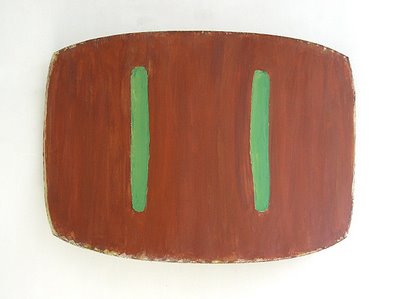
Lure II, 1976, oil on canvas, 36" x 51" c 14"


“I respected him right up until I slit his throat.”
Truman Capote, In Cold Blood


Ron Gorchov is one of those really respected artists that only the Mid-West seems to produce. Respected, as in Jim Nutt respected or Leon Golub respected. Gorchov was born in Chicago in 1930, attended the University of Illinois (my alma mater), and began exhibiting in the late 1950s. Gorchov’s style paralleled that of artists like Frank Stella or Ellsworth Kelly. These three artists contended with the potential in the shape of a canvas to not only contain the painted image but also to give the painting itself form. Hybrids of Abstract Expressionism and 60’s Minimalism, his paintings were cool, interesting, and then largely forgotten. The art world is like that. Although his work has only been exhibited once before in New York, Gorchov has maintained a sort of following; artists like Guy Goodwin and Ellen Phalen owe him a huge debt.

The shaped canvases [generally two vertical parallel lines centered within rounded rectangles] have been compared to electric sockets, riding saddles and shields. I read that in the press release. I also read that he paints the floating shapes in the center of the canvases ambidextrously. The right one is the right handed side, the left etc…. I was oddly struck by these factoids. I was intrigued both by the ambidexterity, and, ironically, the lack of any discernable “hand” in his various marks. In a strange way Gorchov painted himself so much into the painting that he eventually painted himself out of the picture. Since the incredibly cloying work in the Elizabeth Murray retrospective, I don’t want to be told that a shaped canvas is supposed to look like, you know, “a shoe!” It struck me that until I read that these paintings were meant to look like something, I had never really noticed that they were shaped in any particular way. The pieces seemed bent to fit the space in the way that the paint bent to fit the canvas, the way he must have bent to make the mark. Really this is work to be looked at, felt and moved through.

If these paintings resemble shields (a favorite motif, it seems, among the Chicago guys; see Golub, Goodwin, et. al), maybe it is because this type of work ultimately needs defending; there is a delicacy to it that is belied by the size of the pieces. These paintings provide a private pleasure. Really good paintings don’t have to be seen by everyone to still be really good paintings.

Regardless of whether Gorchov faded from prominence by his choice or from critical and/or commercial neglect, the artist is brought back into the light by the current exhibition. Gorchov’s paintings prove to be both vintage and retro simultaneously which, considering that the focus of P.S.1 has been so much about newness lately, is sort of, well, cool.

7/02/2006


Moma & Dada


Dada
The Museum of Modern Art, 11 West 53 Street [btwn. 5th & 6th Aves.], (212) 708-9400.
http://www.moma.org

Through September 11


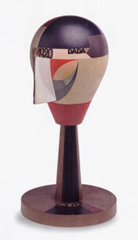
Sophie Taeuber-Arp. Untitled (Dada Head). 1920. Oil on turned wood, h. 11 9/16" (29.4 cm).


I’m not terribly interested in this show, but I really wanted to write that title.

* * *


What a Web We Weave…


Studio in the Park: A Public Art Project
Curated by Karin Bravin and produced by BravinLee Programs. Studio in the Park celebrates the 20th anniversary of Riverside Park Fund.

BravinLee Programs, 526 West 26th St. [betw. 10th & 11th Aves.], Ste. 211, 212.462.4404.
www.bravinlee.com

Through September16

Photo by Luis Gispert


Putting art in any large public park is a thankless undertaking. A lot of people get bizarrely angry at the art [unless it involves cows]. Furthermore, unless under the thumb of a mass totalitarian vision [see The Gates] it is hard for art to unify large outdoor public spaces—especially ones as long, varied and in parts bifurcated and trifurcated as Riverside Park. The answer then would seem to be not to try. Better to try to capture the spirit of the place quietly and artlessly but with grace and good humor.

Studio in the Park is not so much seen as encountered. The art weaves in and out of the park’s precincts much as the park weaves in and out of its surrounding terrain. The park intertwines spectacularly with the West Side Highway, Metro North, the Hudson River and the numerous neighborhoods that abut its impressive length. Similarly, whether by chance or by choice, much of the work in this summer-long show is about lacing, looping and layering.

One of the cool features of Riverside Park is the trains that run under most of it. You can see them rumble by beneath massive grates and through stone arches. Elana Herzog wove pink wires into the gratings by the flower gardens in the 80s. The wires are grouped somewhat in the pattern of the train tracks below them. Sadly, that’s it for this under-realized piece; it’s hard not to wish that the wires were able to puff into the air when the trains flew by, or form a grander pattern or do something. Like Steed Taylor’s Road Tattoos. Taylor’s tattoos are painted onto the path of a promenade up by 102nd St. They are painted with a hi-gloss black latex that will eventually fade away [as many a 90’s tattoo victims wish theirs would]. The tattoo itself forms a looping pattern of ribbony lines—the kind of Celtic thing Angelina Jolie has somewhere on her body.

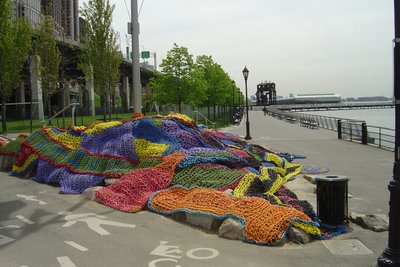
Meanwhile, at the beginning [or end] of the park at 70th St., Orly Genger’s Puzzlejuice delights the eyes and the kids with a simple land sculpture made from colored climbing rope webbed together and draped over a climbing rock formation. The work, placed at one of the park’s most hectic intersections, is in itself a sublime intersection of art, audience and park.

Equally lovely are Gary Simmons’ backstop covers. These airy white fabrics adorned with stars and the words I Wish and Forever are looped to the chain link fences behind the home plates at the 108th St. ball fields. The pieces succeed in bringing to life the aesthetic possibilities of a thoroughly neglected zone and capturing the wonder felt by anyone who has ever stepped into a batter’s box. I hope these covers stay up for as long as they last and set a precedent for the decoration of backstops everywhere.

There are numerous other works that weave their way through the life of the park [except for McKendree Key’s 8,000 orange balls cast upon the Hudson—they bob]. Each piece works to better or worse effect, but all strive to do the park a solid.

Olmstead grasped better than anyone what each of his parks were meant to do for their respective communities and what they could do with the land upon which they were placed. For the challenging terrain of Riverside he chose to create a many stranded park which would stitch together the upper west coast of Manhattan. Studio in the Park manages to illuminate and celebrate the form and functions of the place. Not bad for public art.

* * *


Rusted and Chilled


Richard Serra: Rolled and Forged

Gagosian Gallery, 555 West 24th St [betw. 10th & 11th Aves], 212.741.1111
http://www.gagosian

Through August 11

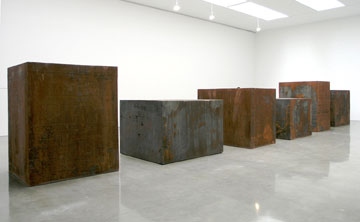
Elevations, Repetitions, Weatherproof steel, 60 x 366 x 6 inches, 2006.

These babies are big and beautiful. Huge delicious chunks that are exactly what they say they are. Gogo has constructed entire rooms to fit the pieces [to the centimeter]. Plus the whole vast space is air-conditioned! Go. Go.


6/17/2006

Bradley Rubenstein is now officially an arthole. Rubenstein is a painter and long time resident of Greenpoint. In the hopes of getting him to review all the shows out in Brooklyn that I’ll never get to, I’m letting him cut his teeth on a museum show.


My Six Year Old Could Review That

by Bradley Rubenstein


No Limits, Just Edges: Jackson Pollock Paintings on Paper

Solomon R. Guggenheim Museum, 1071 Fifth Ave [betw. 89th & 90th Sts.], 212.423.3500
http://www.guggenheim.org/new_york_index.shtml

Through September
29


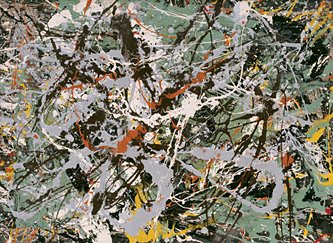
Untitled (Green Silver), ca. 1949. Enamel and aluminum paint on paper mounted on canvas. 22 3/4 x 30 3/4 inches.
The current exhibit at the Guggenheim enjoins the now half an age old debate as to whetherornothecouldactuallydraw and shows Pollock overcoming his personal limitations to develop something other. Pollock did not just develop a way of working, he developed a way of working through: styles, materials and personal demons. He consumed his own innovations with such fervor that by the time he reached his signature poured style he was already a cliché, done. Yes, it is the 50th anniversary of his death or something, and yes, a Pollock show is always (usually) worth seeing, but in this case seeing the drawings in the context of the Guggenheim's über-modern architecture points up the struggle he faced trying to define what it meant for him to be modern.

The gems of the show aren't the delicately laced Duco drawings but the transitional early pieces. Whether Pollock was quoting his shrink in this work, really did a lot of reading up at the library, or was actually trying to unlearn how to draw (see Clement Greenberg) these pieces persisted for him and would be resurrected later in his black and white works like Portrait and A Dream. By the time we get to the end of the Pollock story, we are usually depressed because he had "lost it" (again see Clement Greenberg) or had "fallen off the wagon" (or is that “on the wagon?”) or whatever. I would like to think that he never really lost anything. Maybe these drawings were always lying around the studio, a reminder of just how far he had gone with the work. No matter how tight that final corner he painted himself into was, it was still worlds bigger than the one he had painted himself out of 15 years earlier.

6/05/2006

The other day I saw a man sitting alone at an outdoor café. It seemed as if he were talking to himself. I assumed he was merely talking on a blue tooth. But he wasn’t. He really was talking to himself. I was oddly comforted.

* * *

The Robin Yount of Contemporary Painting

Thomas Nozkowski: Works on Paper

Bravin Lee Programs, 526 West 26th St. Rm 211 [btwn 10th & 11th Aves], 212.462.4404
www.bravinlee.com

Closed


Thomas Nozkowski can best be described as one of those quiet players who puts up great numbers every year and before you know it is ready for the Hall of Fame. He’s a pro’s pro. If he isn’t the flashiest player in the league, he’s certainly the steadiest. Pound for pound his paintings pay out the most consistently interesting rewards to their viewers. In this show oil on un-gessoed [!] paper paintings wring myriad possibilities out of their humble form. Anything you see in them I can see better: graffiti, Klee, Matisse, Lasker—but most of all Nozkowski. He’s been knocking around inside the same four sides of his surfaces with the basically the same elements for 25 years and it’s never boring and seldom precious. Like the great Robin Yount he rarely makes an error.

* * *

Father's Day

Len Servetar

JCC-Y, 900 Route 45, New City, NY, (845) 362-4400
http://www.servetar.com/HTML/len_index.html

Through July 28

Ok, so I’ve completely compromised my journalistic integrity [oxymoron?] by listing this show. Then again, unless your dad is Andreas Gursky or Barry Frydlender, my dad is a better photographer than your dad anyway. Nyah.

At Play, 18" x 20", digital print, 2006

* * *


Mish Mash

Robert Altman: I am what I am
Lothar Hempl: Umbrella


Anton Kern Gallery, 532 West 20th St. [betw. 10th & 11th Aves.], 212.367.9663
www.antonkerngallery.com

Closed

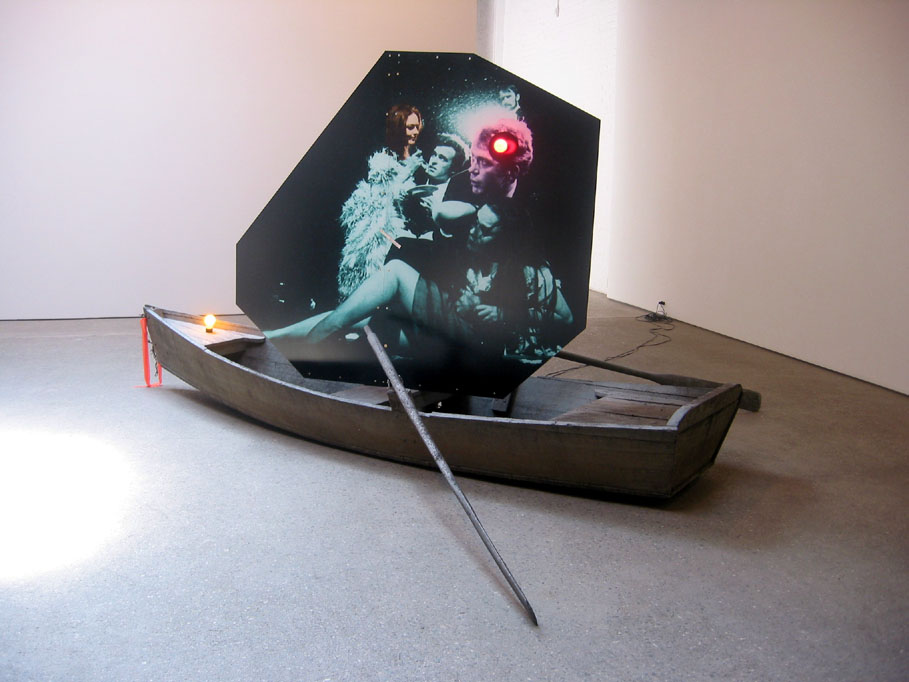
Endlose Reise (Endless Journey), Boat, MDF, photographic paper, lights, 80 x 45 x 128, 2006

So I walked into the gallery. I only saw Robert Altman’s name on the front wall. Saw a bunch of things that looked as if Altman might have made them in his garage when he wasn’t busy not-directing one of his tomes. Hippie art assemblages, photo collages and diamond shaped canvases in early 70s colors with faded frau themes—strictly rummage sale stuff. In the back were stills from Altman’s various films—the potentially money making part of the exhibit. I got to thinking about how celebrities have taken over Broadway plays, children’s books, procreation and now, so it seemed, art making. Then I found out that the stuff in front was by Lothar Hempl. My bad.

* * *

5/23/2006


Amy Fusselman [see About Me] is now officially an arthole. From time to time she will contribute conversations with artists based on what they do to get by. Joe Fig’s last show was awesome, but the life of every full-time painter is somewhat the same [get up, go to the studio, paint, paint, paint!]. Amy will chart the paths followed by the rest of us.


art/work
By Amy Fusselman


Elizabeth Zechel is an artist and Kindergarten teacher at a private school in Brooklyn, NY. Her most recent exhibition featured a series of drawings entitled “Goddamn Bully” at A.I.R. Gallery in Chelsea.

She is currently working on:


-Over 90 drawings of pies for Bubby’s Restaurant’s forthcoming pie book
-Drawings of Chickasaw Indian myths for display in the permanent collection of the Chickasaw National Cultural Center in Oklahoma.
-A book with poet Jen Robinson
-A children’s book for Soft Skull press with poet Matthea Harvey

Where do you work?

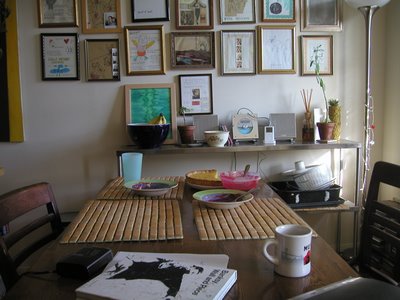
My dining table.
Elizabeth’s table, with pie.

How did you get your teaching job?

I had been waiting tables forever—and couldn’t keep doing that--I didn’t know what I was going to do. I mean, God help me, I even thought about Clown School at one point.

Oh, you are my hero.

I was like ‘What can I do? What do I like? I like to do silly things. I like to fall down. I like kids. Clown school! Of course!’ [laughter]. But it went from waiting tables to thinking about what to do, to even thinking…I took a class at the New School for writing and I was going to write this book and I was all over the place. I was drawing, I was painting, I was da-da-da-da… And then Todd [Colby, Zechel’s husband, a poet] was looking in the Village Voice at restaurant waiting jobs and saw out of the blue: ‘Looking for painters to paint prosthetic hands and fingers.’ And he said ‘You should try that.’ And I was like ‘OK. Sounds good to me.’ [laughter].

So I called up and got an interview. The company was called ‘American Hand Prosthetics.’ It was the trippiest job I ever had. It was… Well, first there was a three-hour audition… They gave us these little plastic swatches …you had to paint with latex paint, and you had to continuously put this liquid in the paint or it would turn into… a piece of silly putty….I felt like Lucy out of the Lucy show because I was looking at the time and I had to match about 25 different colors of skin swatches, and while I’m trying to do this, the paint is drying and I’m like ‘I can’t do it. I’m a loser. I can’t believe I’m the last one here.’ …I got the job.

Yay!

I worked with patients. It was fascinating. There was a guy who just did fingernails. He was amazing. And there was a guy who took the molds. We did arms, hands, toes…Some poor girl has my toe actually.

The prosthetics makers would take a mold of a patient’s right finger, you know, ‘cause the left one was gone, and then they would reverse it. And then …the patients would come in and I would paint. While they were there I would match their skin tones….The last guy I did was this older man who had lost his arm in World War II and I have never been so stressed out in my life because I had to do his entire arm and hand… it was looking orange…so I had to re-scrape the paint and he was being very patient and very sweet and we finally got it right but it was: ‘Let’s just put this arm [the other arm] in the sun for a little bit.’ [laughter].

So this is a long answer to your question, but I had that job and then my mom got sick and I left New York and went to Chicago to help her and I stayed there until she died in July 2001. When I came back, I needed a job and I wasn’t going back to the hand place…

Right.

Because I needed something a little more uplifting. [laughter]

Then I bumped into this woman who I had waited on years ago. She was a realtor in Brooklyn and she’s like ‘So what are you going to do?’ and I said ‘Well, I really don’t know. I was thinking maybe teaching art classes’ And she said you should call X and Y at these schools so I called...and interviewed and became the Afterschool Head at this school for a year. Then… they bumped me up to kindergarten. And there I stayed;… I’ve been there six years.

What’s your day like?

Whole day?…Get up at ten of seven, have my ritual oatmeal, coffee…

Uh-huh.

And we have everything. We have math, we have reading, we have this and that…. We have horrible fights between children, you know we have lots of happiness, lots of sadness and then it’s time to go home.

…I usually get home around 3:15. Get here, chill out for a little bit and start drawing.


5/11/2006

Yeah, well...

Bill Henson

Robert Miller Gallery
524 West 24th St. [btw 10th & 11th Aves.], 212.366.4774
http://www.robertmillergallery.com/

Closed

Ok, so they’re gi’normous nudes and partials of young nubiles mixed with late summer dusk shots of children’s toys abandoned in the grass. They’re gorgeous. Sue me.

* * *


Bashley Ackerton

Ashley Bickerton

Lehmann Maupin
540 West 26th St [btw 10th & 11th Aves.], 212.255.2923

Closed


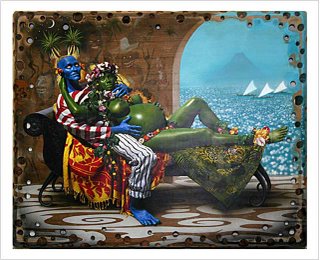
A.B. is the Jimmy Buffett of the art world having abandoned civilization some time ago [though Bickerton chose the South Pacific over Florida and seems to prefer crystal meth to margaritas]. This show presents a continuation of Bickertons über-cranked hyperreal paintings on wood now with the addition of print elements, aboriginal style patterning and holes. The exhibit also celebrates earlier moments in the artist’s history with some terrific sculptures and combine pieces. The Edge of Things—S. Pacific, though of dubious ecological provenance [it’s made mostly of coral], is a welcome gentle touch amid the psychotropic postcards from paradise.

Quite possibly the first time I’ve had a good time in the plywood pavilion—Tracy Emin’s Soho skankfest notwithstanding.

* * *

What’s on Your Worktable?

Joe Fig

Plus Ultra Gallery
637 West 27th street [btw 11th & 12th Aves.], 212.643.3152
http://www.plusultragallery.com/index.html

Closed

I’m jumping on this show with both feet.

I’m a sucker for models. No, not those willowy creatures who never pay for drinks, I’m a sucker for scale models. I was all over Michael Ashkin before he lost all sense of perspective about his work [pun intended] and I’ll always take a second look at anything that attempts to recreated our world in miniature [one of my first enduring museum recollections is of the scale model Aztec temple on the ground floor of the Brooklyn Museum].

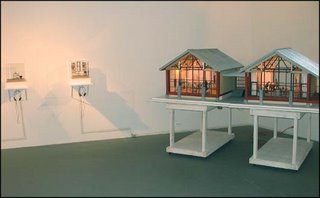
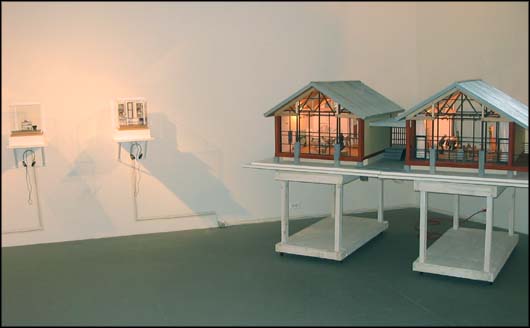
Joe Fig’s project is a very straightforward and very generous endeavor. He lays out for the viewer/listener/reader the work lives of the painters. He does so in a direct and refreshingly artless manner—more Museum of Natural History than MOMA. His work is a gift for the small group of people who actually give a shit about painting [mostly other painters]—a rare glimpse into those things about which we’re probably most curious [what brand of paint do you use?, what kind of table do you have? what’s your day like? Etc…]. It’s the best mix of art and design porn.

With meticulous care and thorough going inventiveness, Fig recreates each artist’s work table and its immediate environs and accompanies it with a fairly brief recording of an interview with each artist. Earphones hang off the pedestals on which the miniatures rest. The respective interviews play as we ogle the minutiae of their lives. The interviews are for the most part short, crisp and on point.

Just the other day Rodney A. asked me if I would ever review after only having seen it on the web. While I never would [we have to have at least one form of unmediated experience left in our lives], nevertheless, I would be able, in a pinch, to get a pretty good idea of Fig’s exhibition by checking out the gallery web site. Like the show the site is a straightforward gift to the viewer.

Artists in the show include a lot of great players from Dana Schutz to Joan Snyder, Chuck Close and a terrific roster in between: e.g. Matthew Ritchie, Will Cotton [he only uses 5 colors!], Karen Davie, Fred Tomaselli, Amy Sillman and Alexis Rockman [see below]. You could spend a couple of hours pouring over these dioramas, to say nothing of the larger piece leftover from an earlier show “April and Eric.” While it is fascinating to look into Gornik and Fischl’s dream-come-true his and her studios, it’s also just too much perfection to bear.

* * *


4/25/2006

Good Ship, Man


Matthew Barney: The Occidental Guest

Gladstone Gallery
515 West 24th Street [btw. 10th & 11th Aves.], 212.206.9300

http://www.gladstonegallery.com/default.asp

Closed


Matthew Barney, Torii, 2006. Vivak, cast polycaprolactone thermoplastic, and acrylic; 5 x 23 x 27'
When the prettiest boy in school decides that the prom song is going to be by Bread, and that we are all to be dressed like Scottish satyrs and smeared in Vaseline, who are we to argue? Who are we poor, ugly pantshitters to criticize?

And what are we to do when the prettiest boy in school takes to the prom a really cool, exotic girl from out of town? Oh man. And then they make a movie together! Oh man. This is what Brangelina’s baby would look like if he were born an art film. Too fucking gorgeous to bother.


God, I hate myself so much.


* * *

Free Running

It is perhaps the only thing purely and beautifully born of the great social experiments/disasters that were and are the large housing projects that swept the world from the 30’s on. From the Soviet bloc of flats to the council houses of Great Britain and the Corbusian nightmares of the French banlieues—the only good thing to have been directly inspired by this soul deadening architecture is a sport so pure it requires no equipment, apparatus, field or court. Crumbling concrete walls and stairs will do nicely for an arena. A pair of sneakers for equipment. That’s it.

The French call it Parkour [they have a name for everything], but the best name for it is Free Running. The combination of creativity and virtuoso physicality involved in the sport is exhilarating and downright liberating. Take a look at the clip in the link below and see if you don’t agree:

http://video.google.com/videoplay?docid=515642196227308929&q=russian+climbing

* * *


The Little Dog Laughed

Amy Sillman

Sikkema Jenkins & Co.
530 West 22nd St [btw. 10th & 11th Aves.], 212.929.2262
http://sikkemajenkinsco.com/index.html

Closed


Amy Sillman—Get the Moon, 2006, Oil on canvas, 80 x 69 inches
If you wanted to rid New York city of a good many of its painters, you would have done well to set off an IED at Amy Sillman’s opening last Saturday. All the close-shorn and bespectacled painters from Brooklyn and lower Manhattan gathered to catch glimpses of each other against the backdrop of the diminutive painter’s strapping abstractions.

Amy gave Max, my older son, a melted candy the moment she met him—as one might hand garlic to a vampire. A couple leaned against the wall and peered out from behind curator and architect weight eyewear respectively. Another woman strode about purposefully in her Skull & Bones pants hoping to become a conversation piece.

I saw some people who clearly had forgotten me and others whom I wish had. Painting students and recent grads did the bulk of the smoking in front of the gallery. From the street you could watch Brent and Michael entertain clients in the conspicuously front/back room.

And the dish ran away with the spoon.


Prescient, Amn’t I?

Barry Frydlender will be having a solo exhibition at MoMA next year,early summer, in the photography galleries.


Life is short. Art is long. You never know.
artholes!


4/15/2006

Time Laps

Barry Frydlender
Andrea Meislin Gallery, 526 West 26th Street, #214 [btw. 10th & 11th Aves.], 212.627.2552.
http://www.andreameislin.com

Closed


Barry Frydlender is making photographs that succeed on so many levels and with such stunning breadth that the viewer is left to wonder: Why hasn’t he hit really big yet?

Well first of all he’s not young. Ew. Second of all he’s from Israel and that’s so, you know, er, problematic. And third, his large photographs are unabashedly masterful in their technical accomplishments: marvels of time lapse digital overlay that blend to seamless wholes into which all time seems to collapse upon itself. Theses are not callow pics of 20somethings adrift in nature nor are they monothematic concept images trotted out ad infinitum. Frydlender loves and cares about his subjects, some more intimately than others, but always with the spirit of camaraderie that comes from living in a small nation which, for all its issues, still has the feel of a groovy summer camp about it.

What are we to make of that?

His method is not a gimmick. It is has become his way of seeing. He takes many, many exposures of a site--a beach, a swimming pool, a café, a subway car--from minutely different perspectives. He gathers these fragments to form a single image with nary a blur or stilted crop. In this way Frydlender is able to capture time and narrative in a single image, be they scenes of action or repose, epic tableaus or intimate portraits.

It is curious, or perhaps fitting, that Frydlender often chooses as his time lapse subjects those who seem to be going most slowly. Some of his subjects are even asleep a la Warhol. One of his photos, Take a Picture of Me, features a composite portrait of a woman on a beach taken over a year’s time. When you look at some of his images, you know something is up but not exactly what. Even where you see the hand of time at play as when a red headed woman appears here and there at once on a contested beachfront settlement, Shirat Hayam (“End of Occupation?” Series #2), something in the overall atmosphere of the place makes you experience her movement as if in real time.

Despite the anger and sense of violence that hovers in the air like dry heat, these images and the people in them exude a languor that definitively captures the laid back aura of the land even today. There would be more frenetic tension in a photo of the entrance to an average American mall than there is here in the face-off between settlers and the army whose job it was to remove them.

On the wall opposite this photo, in Waiting, 38 Years (“End of Occupation?” Series #1), a line of Palestinian men and boys stand waiting and watching the scene that plays out in the photo across from them [this is actually as it occurred]. The Palestinians are waiting on a hilltop above the beach for the settlers below them to be dispersed. An older man among the teens and boys writes his path across the tableau, his steady patience that of the carrion bird waiting, knowing eventually his moment will come.

There are other gems in this relatively modest exhibit. In The Blessing a party of Hasidic men in a park on a beautiful day cast a simple but resonant color palette thanks to their uniform garb. The balance of colors are pitch perfect painterly.

Estates, however, is the best among bests. Read from the left, we first encounter a cemetery behind a pool which is in the back of a slightly faded luxury apartment building. The time lapse eye exposes itself to the ancient cemetery again and again waiting for something to move, the dead to rise, but here, alas, nothing does—not even a stray cat. In the large pool, 2 swimmers pass each other in opposite directions. Only it’s the same swimmer. Passing himself. Laps. Lapse.

There is no sweeter sadness than crossing paths with your younger self: a swimmer crossing in his own wake, a people returning to a land.

An instructional poster for swim safety hangs towards the back of the pool area. It is printed in imperfect international English and inadvertently points to the truth of the slow, inexorable downward pull of these lands, these scenes. It’s titled in red capital letters: DROWING. We are all drowing.


Life is short. Art is long. You never know.
artholes!


4/06/2006

artholes

goodbye to the inspeak of the overlords

farewell to the mespeak of the cybernaughts

welcome to the tautspeak of the artholes

Brad Said

Brad said I shouldn’t call this a blog. “Blogs are so…you know. Try calling it a porn site.”

Welcome to my porn site.

I started writing on art on the heels of the ’93 Whitney Biennial, so it’s only fitting that I resume on the heels of the current Biennial.

Tit for Tat

Whitney Biennial 2006: Day for Night

Whitney Museum of American Art, 945 Madison Ave [btw. 74th & 75th Sts.], 212.570.3633. http://www.whitney.org/

Closed
Someone called it the Post-America Biennial. It would be better to call it the Post-Traumatic Post-Op TransAmerica Biennial. That would be more like it. There is no Post-America.

Any pretense of art world globalization principally centers on an extended jet set of art professionals and collectors; all the work and the people are essentially the same—it is a traveling show that has the gesture of universality with none of the bitter aftertaste. Although jet-setting is far more accessible than it once was, insofar as I am tethered to this bedrock, I prefer the notion of grasping the global through the local. As the Senator from Massachusetts once said: “All politics is local” —even art politics.

Now that the notion of a themed biennial has been introduced, I’d like to propose a few of my own:

1) The Hierarchical Biennial: The Bucksbaum Award is a start, but I want a real judged show in which the exhibiting artists are pitted against each other in various hard and soft categories. Prizes are awarded by jury and, hold your nose here, the public!

2) Video-Free Biennial: Why not? We’ve already had painting-free biennials.

3) All Local/All World Biennial: Artists who come from somewhere: live/work in the Metro-area, America or truly international destinations, i.e. Westchester, Wisconsin or Ghana, who execute work of their place—not pale imitations of art mag art.

4) All Women Biennial: Isn’t about time? Besides, then we wouldn’t have to hear about the dearth of women artists in the Biennial until the following Biennial.

5) All People of Color Biennial: Ditto. [Except no fair recycling the usual suspects. There are other people of color in the world besides those Thelma Golden discovered.]

As for this one….

My favorite professor of gallery administration stresses that if you are going to curate a themed exhibition, you should shape your theme to the works and not vice versa. Ok, so right away they fucked that up.

The 4th floor played the theme day for night as black for white [and gray]. The first space off the elevator featured Uri Fischer’s busted room, The Inelligence of Flowers, which contains another piece of his, Untitled (branches), an inexorable aluminum slowly rotating and dripping wax and a large b&w painting by Rudolf Stingl, Untitled (After Sam) [what’s with all these untitled pieces having titles?]. Together the works make for a handsome gallery—something that might work well as a Helmut Lang showroom. Next to that Dan Colen’s heavy for light pseudo-cement pieces sort of reminded me of the clothing Santino did for Project Runway: long on personality and ambition, short on actually delivering the goods.

The 3rd floor seemed to interpret day for night as good for bad. Individual artists were called on to show their best and the worst pieces respectively. Hannah Greely contributed a good and then a bad sculpture:, Last Stand, a hat rack made of bones was at once raw and touching while her other piece, Silencer, beat the tired fucked-up baby sculpture trope firmly into the ground. Mark Grotjahn did some good, funny white on beige geometric abstractions: White Butterfly, White Butterfly, and Yellow White Butterfly [all Untitled, naturally] and then, like a suitor who picks his nose at the key moment, Grotjahn lost my heart before he gained it by also displaying Blue Face Grotjahn. I don’t care that he generally paints his abstractions over this kind of gestural expressive romps—he’s wise to paint over them: we don’t need to see them.

Lisa Lapinski’s self conscious Nightstand should have been included on the good/bad floor, the best and the worst of the artist was embraced in one piece. The oversized night table had brilliant drawers that folded out in waves. T’were beautiful. Unfortunately Lapinski didn’t feel that such formal invention was enough. She had to go and add “content” like msg to the mooshu—she junked it up with a with a bunch of crap too banal to list.

The second floor seemed to play out day for night as good for bad behavior with Billy Sullivan’s slide show leading the way displaying the now seemingly innocent [good] bad behavior of yesteryear [70s etc.] Although Sullivan also continued the good art/bad art trope with some bad full portraits paintings of his own. Further on, in a display of the kind of stunning racial insensitivity that only Europeans can still muster, a bunch of black artists were stuck together in one room [toward the back] along with displays of Ku Klux Klan and white supremacist themed art. Get it? Day for night/whites for blacks? “Only zees time Phillipe we will do ze theme in a racial way—it is brilliant! N’est pas?”

Otherwise, other trends stumbled along. Along the female photographer front, let us hope and pray that Hanna Liden is the last entrant in the semi-clad teen girls in the woods genre—less a milieu these days than a millstone. Conversely, Angela Strassheim’s photos show us something we might want to see again: the pristine rapture of a born again family going about its life. Ann Collier’s Cover [California Girl] was cool but the rest of her photos were predictable concept-y stuff: photos of record covers—covers of covers. Ugh.

Finally, it was amazing, but in all honesty there were no videos worth dallying over except Pierre Huyghe’s handsome meditation, A Journey That Wasn’t. Paul Chan’s 1st Light did a lovely job evoking the long shadow that Marcel Duchamp cast over this show via The Bride Stripped Bare…. But really did we need an entire room of recreated Duchamps by Sturtevant? Aping Duchamp is not the same as being Duchampian. No one here was. Or maybe…

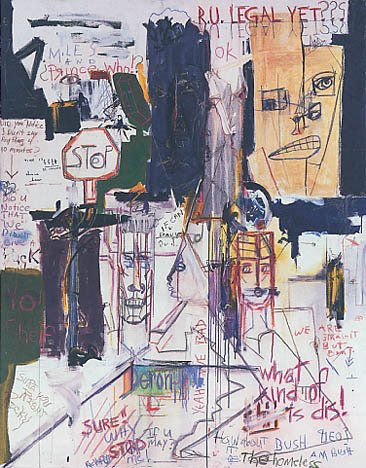
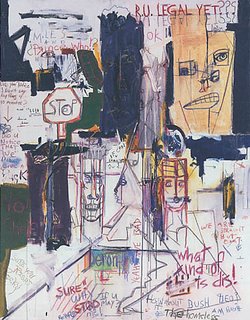
In the spirit of resurrecting defunct notions of good and bad [or in the hopes of being Duchampian], I give u RU Legal? by Miles Davis. A rumor had been floated that the work was really a hoax perpetrated by David Hammons. Had it been so, the piece would most certainly have taken “Best in Show” [and “Most Duchampian”] honors. However, although Hammons may have wished he’d done it, the painting, sadly, is genuine [http://servercc.oakton.edu/~larry/miles/main/paintings.html]. Painted in the last years of the legend’s life, RU looks like a teenager’s take on Basquiat. As talented a trumpeter as Davis was, that’s how untalented a painter he was; RU Legal [or RU Legal Yet? as it is titled in the site above] is the visual equivalent of Michael Jordan playing baseball. As such, and with a heavy heart, I award the painting—“Worst in Show.”

* * *

Inka Dinka Don’t

Inka Essenheigh

303 Gallery, 525 West 22nd St [btw. 10th & 11th Aves.], 212.255.1121.
http://www.303gallery.com/

Closed

For a long time I’ve resisted judgment on Essenheigh [or at least judging Inka from on high]. I’ve also resisted making any references to Jimmy Durante. Now I’ve failed to resist on all counts. I’ve withheld judgment because I didn’t want to be hating on her just because she gets to do big fun looking paintings and sell them for lots of money while the rest of us have to work for our suppers. Now I can hate on her for more than that.

These recent paintings are straight assembly line canard. Each canvas is coated uniformly in its own tasteful background color right around the edges. Images are painted on top generally from dark to light building up imagery straight out of the computer-generated playbook—there may even be a shortcut for these particular distortions: oddish tableaus of figures in situ melting, drooping or swooping into and through each other to no particular end. These things aren’t even as fun to look at as most of Essenhiegh’s earlier extreme abstractions. Kudos to the curatorial machinations behind this show though. The least of the works Inka crinked out is hung alone in the back room beneath a fabulous skylight. By showcasing the thinnest and most under-painted [and not good under-painted] work in the exhibition, the gallery tries to spit shine the turd and pass it off as gold. A gutsy gambit but we’re not buying.

* * *

Glücklich BuenaVista

Lucky DeBellevue

Feature Inc, 530 West 25th St. [btw. 10th & 11th Aves.], 212.675.5772.
featureinc@feautreinc.com

Closed

First of all his name is too good. Second of all they’re pipe cleaners not chenille stems…ugh. In spite of that and in spite of never really being terribly moved by the work—I am moved by the work. These simple sculptures each humbly and movingly play on the nature of the support; the pieces literally and heartbreakingly address one of the fundamental issues of sculpture by replacing classic armatures with canes, crutches and showers stools. In one piece, Cuirass, three clear minibike half-torso shields surround a green chenille blob of a drooping heart. Though less about support than protection, Cuirass reveals the vulnerability at the soft center of DeBellevue’s work. His pieces, barely able to stand up for themselves, nevertheless manage to do just that with the help of the artist’s strong and loving embrace.

For this exhibition, the gallery’s usual policy of group shows only [except for Tom Friedman] hurts the work. Hemmed into too small a space, the sculptures seemed crowded and diminished thereby. For this show the paintings, even DeBellevue’s charmingly slight 2D affairs, are the things that you bump into. DeBellevue’s work needed and deserved room to lean. Lean on Lucky!


Life is short. Art is long. You never know.
artholes!